
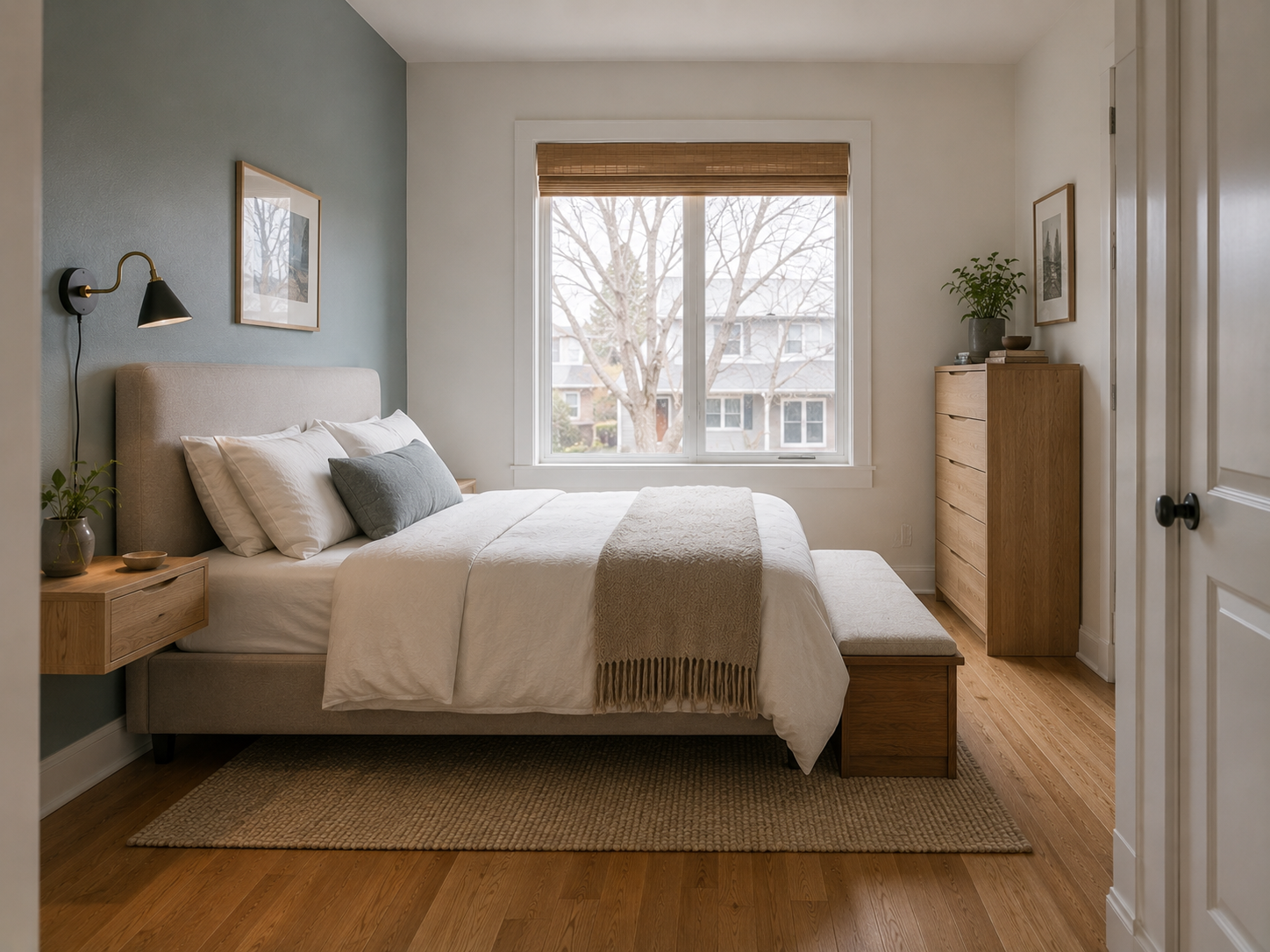
Start with the bed. Choose its size and position before buying anything else, because almost every other furniture decision depends on the space left around it.
A small bedroom becomes frustrating when furniture fits individually but doesn’t work together. The dresser blocks the closet. The nightstand crowds the bed. A chair becomes a place to dump clothes because there’s no clear walking path.
Good small bedroom furniture solves those problems before they happen.
The goal isn’t to squeeze as much furniture as possible into the room. It’s to choose a few pieces that give you storage, comfort, and useful surfaces while leaving enough floor space to move around.
Measure the Room Before You Shop
Take five measurements before opening a furniture website:
- Room length and width
- Door opening and swing
- Closet opening
- Window position
- Distance between the bed and walls
Then measure the furniture you’re considering, including its depth.
Depth gets overlooked. A dresser that’s only a few inches deeper than another option can make a noticeable difference in a tight bedroom.
For a small room, I’d aim to preserve roughly 24–30 inches of comfortable walking space around the main furniture where the layout allows. More is better, especially near doors and closets.
Use painter’s tape on the floor to mark the footprint of the bed, dresser, and nightstands. Walk around the outline before ordering anything.
That simple test catches a surprising number of bad layouts.
Buy the Bed First
The bed is the largest piece in most bedrooms, so it gets first priority.
A queen bed measures about 60 × 80 inches. In a 10 × 10-foot bedroom, that leaves limited room for additional furniture once you account for walking space.
A full-size bed measures about 54 × 75 inches, giving you more breathing room.
That doesn’t mean everyone with a small room should downsize to a full. Think about how you sleep and how long you plan to live with the setup.
I’d rather have a comfortable queen with fewer pieces around it than a smaller bed surrounded by unnecessary furniture.
Consider a storage bed
When closet space is poor, the area beneath the bed becomes valuable.
A platform bed with drawers works well for spare bedding, seasonal clothing, shoes, and luggage.
Before buying, check how far the drawers extend. A storage bed beside a wall or dresser isn’t useful if the drawers can’t open fully.
Choose Nightstands for Function, Not Matching Sets
You don’t need two large bedside tables just because bedroom furniture is sold in pairs.
A small bedroom might work better with one compact nightstand and a wall-mounted shelf on the other side.
Think about what actually needs to live beside the bed: phone, charger, glasses, book, lamp, and perhaps a small personal item.
That’s not much.
A floating nightstand is especially useful because it keeps the floor underneath open.
The wall space beside the bed becomes storage without adding another set of legs to the floor.
Pick a Dresser That Fits the Wall, Not the Empty Space
A common mistake is buying the largest dresser that technically fits.
Don’t.
A dresser needs clearance for its drawers, room to stand in front of it, and enough space for people to walk past.
Measure the wall first, then measure how far the drawers extend when fully open.
A tall, narrow chest can make more sense than a six-drawer horizontal dresser when wall width is limited.
For example, a 36-inch-wide vertical chest might provide useful clothing storage while leaving room for a hamper or narrow mirror beside it.
Use Vertical Storage Before Adding More Floor Furniture
Small bedrooms have one major advantage: ceiling height.
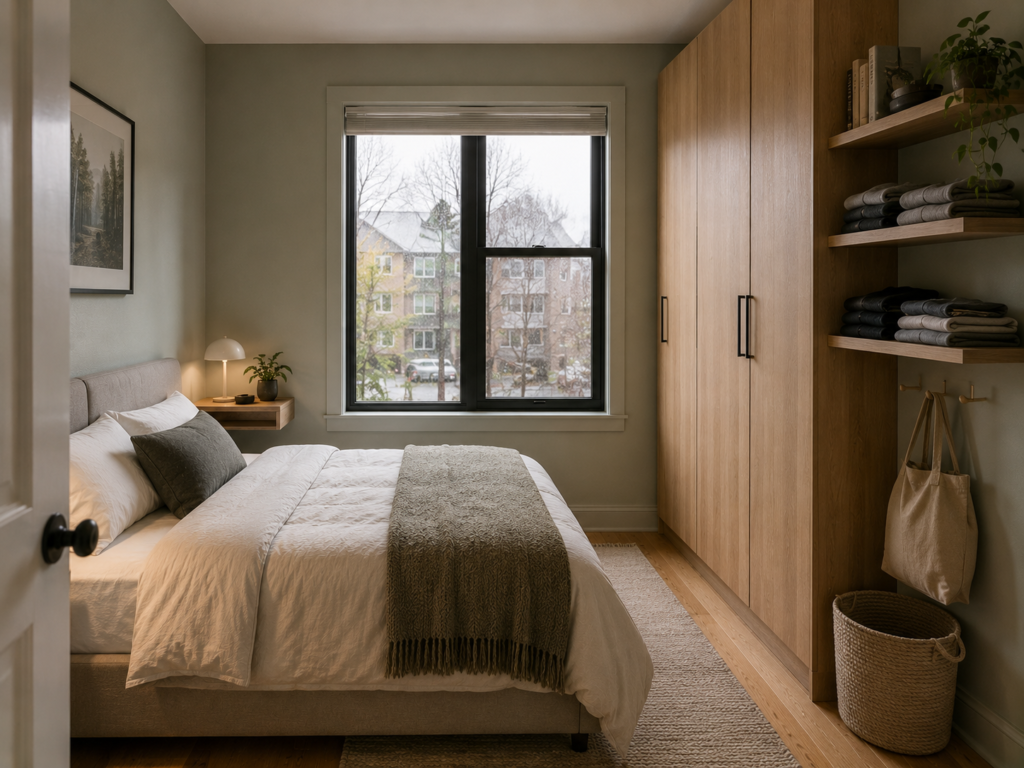
A tall wardrobe, narrow bookcase, or wall-mounted cabinet uses space that would otherwise remain empty.
This is especially useful when the floor is already occupied by the bed.
A tall bookcase around 10–12 inches deep can hold books, baskets, folded clothing, and accessories without sticking far into the room.
Keep frequently used items between waist and eye level. Put seasonal items higher up.
Skip the Bulky Bedroom Chair
A bedroom chair sounds useful until it becomes a permanent clothes pile.
In a genuinely small room, I’d skip a large accent chair unless you actually use it for reading or getting dressed.
A slim bench at the foot of the bed or a small stool gives you somewhere to sit without consuming as much visual and physical space.
The furniture should earn its place.
Consider a Narrow Bench at the Foot of the Bed
A bench can be useful, but size matters.
Choose one that’s narrow enough to preserve a comfortable path around the bed.
A storage bench adds another advantage: the space inside can hold extra blankets, pillows, or seasonal clothing.
Don’t push it so close to the bed that you can’t comfortably walk between the two.
Use a Wall-Mounted Desk for a Bedroom Office
Bedrooms increasingly have to do double duty.
A conventional desk might consume valuable floor space, especially when the room already contains a bed and dresser.
A folding wall desk gives you a workstation when you need one and folds away afterward.
Pair it with a stool that slides underneath.
This setup works particularly well in a bedroom where working from home happens only a few days a week.
Don’t Buy Furniture Sets Just to Make Everything Match
Matching bedroom sets are convenient, but they’re not automatically the best choice for a small room.
A bed, two nightstands, dresser, chest, and mirror from the same collection can quickly make a bedroom feel crowded.
Instead, choose pieces based on their jobs.
A simple wood bed can work with a slim black nightstand. A vintage dresser can work with a modern lamp. A floating shelf can replace the second bedside table.
The room feels more personal, too.
Use the Corners Carefully
Corners are useful, but they’re easy to waste.
A narrow corner desk can create a small workstation. A tall plant can soften an empty corner. A vertical cabinet can provide additional storage.
Don’t automatically fill every corner with furniture.
An empty corner is sometimes what makes the rest of the room feel spacious.
Keep the Closet Door and Drawers in Mind
Furniture placement should follow movement.
A dresser shouldn’t interfere with the closet. A nightstand shouldn’t prevent the bedroom door from opening. A storage bench shouldn’t make the route around the bed awkward.
Open everything during your layout test.
Open the closet.
Pull the dresser drawers out.
Sit on the bed.
Stand at the foot of it.
Walk toward the door.
You’re testing the bedroom as a person uses it, not as it appears in a photograph.
A Realistic 10 × 10 Bedroom Setup
Imagine a 10 × 10-foot bedroom with a queen bed, one small closet, and a window centered on the opposite wall.
Instead of adding two nightstands, a large dresser, a chair, and a desk, I’d keep the furniture focused.
Place the queen bed against the longest practical wall. Use one compact nightstand. Put a narrow vertical dresser where it doesn’t interfere with the closet. Add a floating shelf on the opposite side of the bed.
Now the center of the room stays open.
That empty floor isn’t wasted. It’s what allows you to move comfortably.
What Furniture Should You Skip?
Some furniture looks useful in a showroom but makes little sense in a small bedroom.
Oversized dresser
More drawers aren’t helpful when the piece dominates the room.
Deep nightstands
A nightstand that’s 20 inches deep doesn’t need to be beside a bed if a 12-inch model holds everything you need.
Large accent chair
Don’t sacrifice walking space for a chair that becomes a laundry basket.
Wide bookcase
Choose height instead of width when floor space is limited.
Extra chest of drawers
Before adding another storage piece, check whether vertical storage or under-bed storage solves the problem.
Choose Furniture That Does Two Jobs
This is where small bedroom furniture becomes genuinely useful.
A storage bed provides sleeping space and clothing storage.
A storage bench provides seating and hidden storage.
A folding desk provides a workspace without permanently occupying the floor.
A wall-mounted mirror adds function without needing another piece of furniture.
A narrow bookcase can hold books, baskets, plants, and clothing.
Every piece doesn’t need two functions, but the more important the furniture is, the more useful extra functionality becomes.
Make the Furniture Look Lighter
Furniture scale matters, but visual weight matters too.
A solid dark wardrobe stretching across an entire wall will feel heavier than a similar-sized piece with a lighter finish and visible legs.
For paint, Benjamin Moore Pale Oak OC-20 gives a soft neutral backdrop. Sherwin-Williams Alabaster SW 7008 is another option for a warm off-white room.
You don’t need to make everything white.
Instead, avoid filling the room with too many heavy finishes competing for attention.
Wood, linen, simple metal, and a restrained color palette keep the room from looking visually busy.
How Much Should You Spend?
Put the largest part of your budget toward furniture you use every day.
That usually means the mattress and bed first, followed by storage pieces that solve an actual problem.
Decorative furniture comes later.
A cheap nightstand that does its job is perfectly fine. A poorly built bed frame that squeaks every night is not a bargain.
For Amazon purchases, check the assembled dimensions, materials, customer photos, weight capacity, assembly requirements, and return policy before ordering.
FAQ
Can I put a dresser in front of a window?
You can, but the dresser should not block the operable portion of the window or interfere with curtains and blinds. A low dresser works better than a tall chest beneath a window because it preserves natural light and sightlines.
Should a small bedroom have a rug?
Yes, but size and placement matter. A rug that is too small can make the bed look disconnected from the rest of the room. Positioning a larger rug partially underneath the bed creates a more grounded arrangement while still leaving visible flooring around the edges.
Where should a mirror go in a small bedroom?
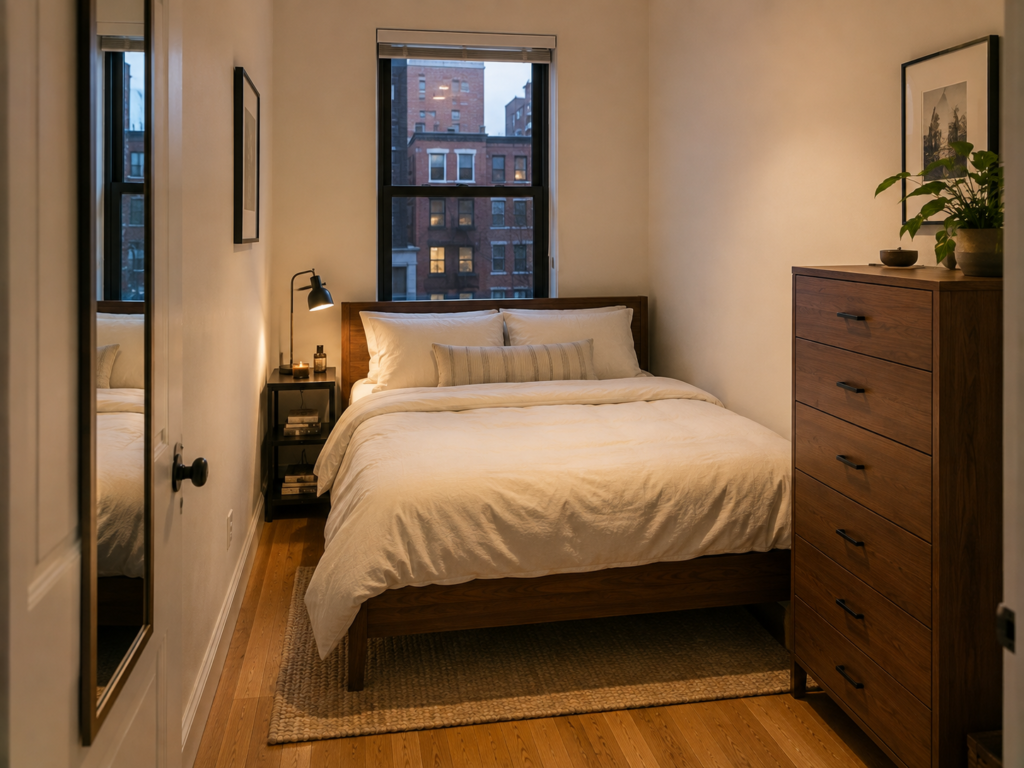
Place a mirror where it reflects useful light or an attractive part of the room. A full-length mirror mounted behind a door is particularly useful when wall space is limited.
How high should bedroom furniture go?
There is no universal height for every piece. Match furniture height to its function and surrounding pieces. A floating nightstand should sit comfortably beside the mattress, while tall storage should stop short of interfering with ceiling trim, vents, or doors.
Final Takeaway
The biggest mistake is trying to furnish every empty section of a small bedroom.
Buy the bed first, solve storage second, protect your walking space, and only add another piece when you can clearly explain what job it performs.