
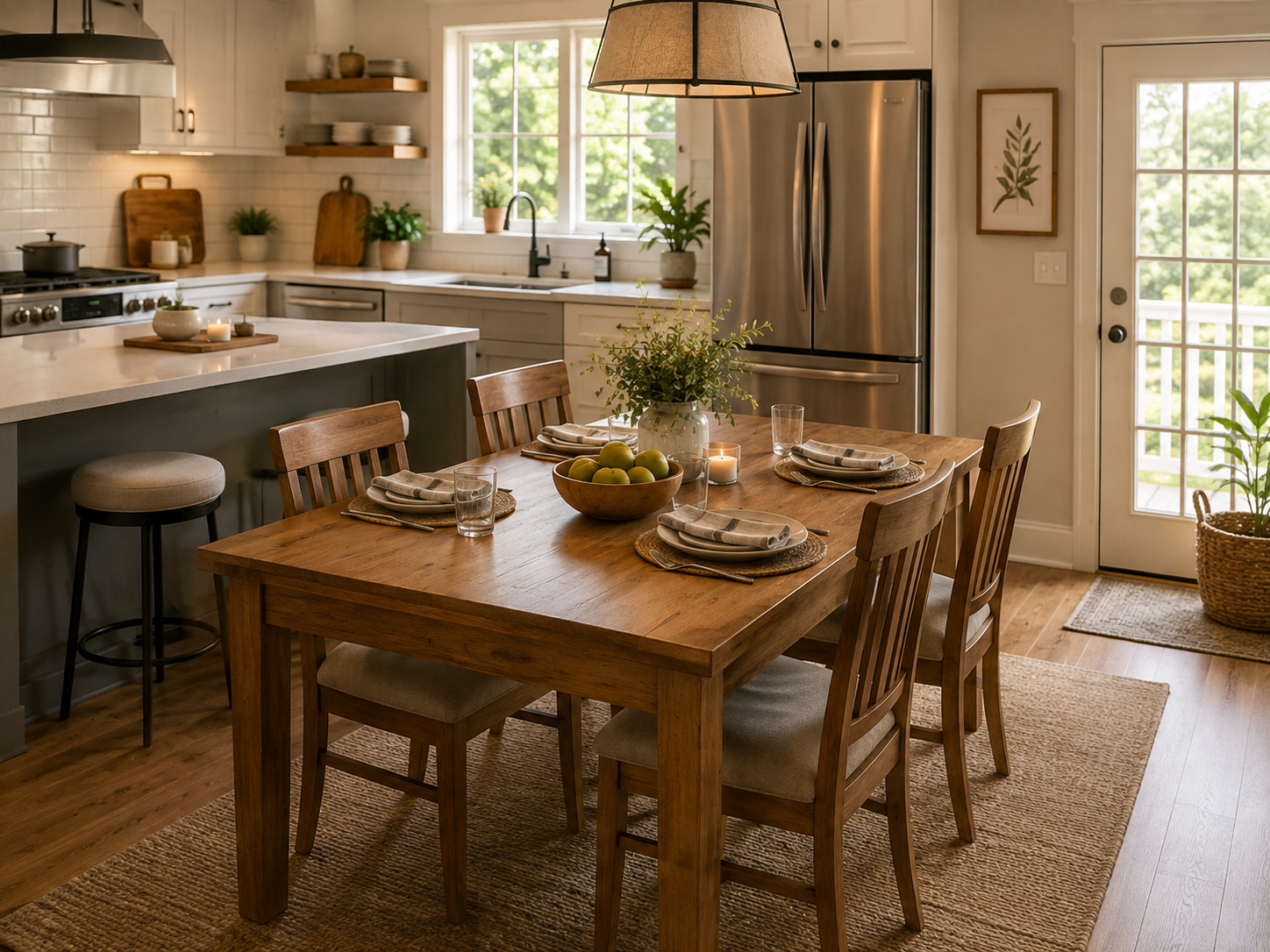
Most kitchen table shopping goes wrong for one reason: people buy the table that looks good in the store, then get it home and realize it doesn’t actually fit how their family eats, works, and moves through the kitchen. The size is off by a foot. Chairs bump into the counter. Or a family of five ends up with a table that only comfortably seats four.
This guide walks through the nine things that actually matter when picking a kitchen table — sized to your space, shaped for your habits, and built for how your family really uses it, not how a showroom display looks.
Quick Answer
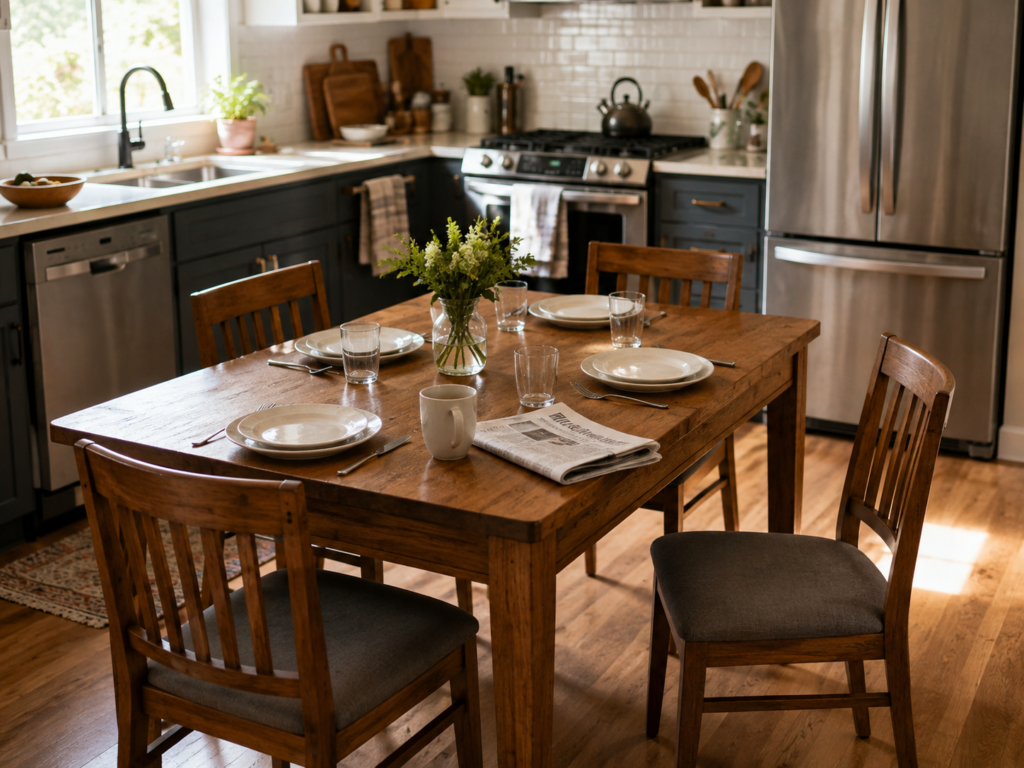
The right kitchen table should fit your room, seat your family comfortably, and suit your space. Round and oval tables work well in smaller rooms, while rectangular tables are better for longer kitchens and larger families. Once you get these basics right, choosing the style and material becomes much easier. If you’re also weighing a full dining set rather than just the table, our dinning room table sets guide covers style and budget in more depth.
1. Measure the Room Before You Measure the Table
This is the step most people skip, and it’s the one that causes the most returns.
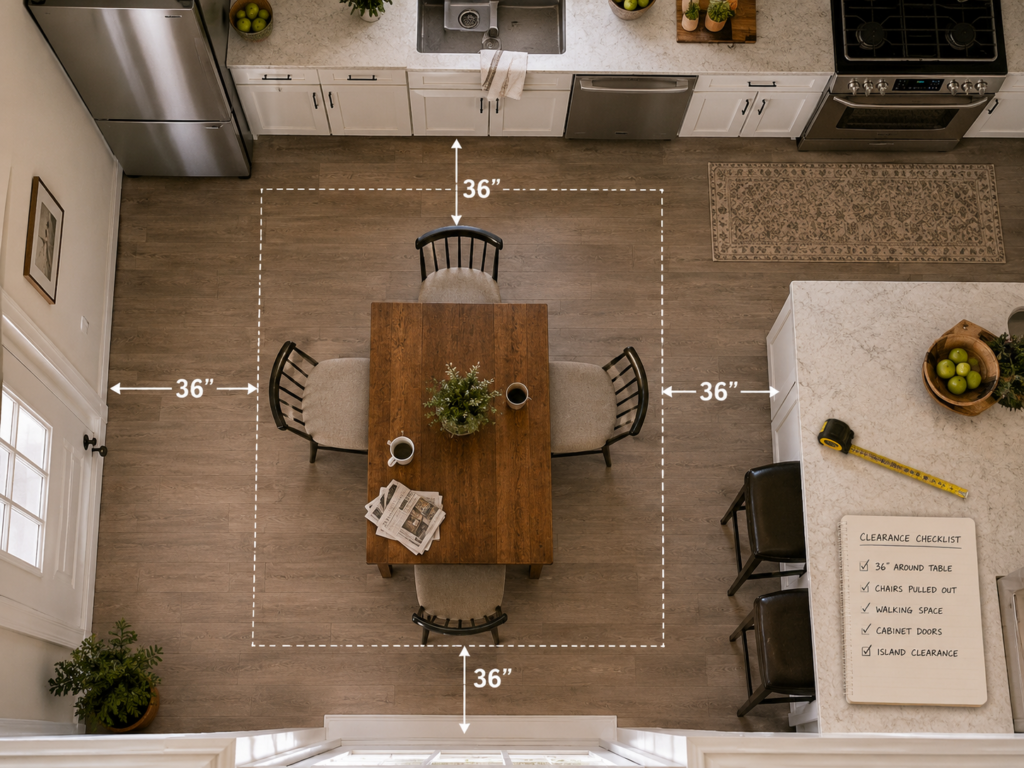
Start with the footprint of the space where the table will sit — not the whole kitchen, just the eating area. Then account for clearance, not just the table itself.
A workable rule of thumb: leave at least 36 inches between the edge of the table and the nearest wall, counter, or appliance. That’s enough room for someone to pull out a chair and for another person to walk behind them without squeezing past. In a tight galley kitchen, 42–48 inches gives you breathing room if the budget for square footage allows it.
If your kitchen is on the smaller side — say, under 100 square feet for the eating nook — a 36-inch round table or a 48-inch oval will usually fit better than a rectangle, because it doesn’t force you to navigate sharp corners in a tight walkway.
Best for small kitchens: round or drop-leaf tables under 42 inches. Best for larger, open-plan kitchens: rectangular tables 60 inches or longer.
Things to consider: Don’t measure just the table’s listed dimensions — measure with the chairs pulled out. A table that’s technically 42 inches wide can need close to 6 feet of total depth once chairs are added.
2. Know How Many People You’re Actually Seating — Not Just Today
Families change size faster than furniture does. A table bought for a couple with a toddler often needs to fit five or six people within a few years.
A general seating guide:
- 2–4 people: a 36–42 inch round table, or a 48-inch rectangle
- 4–6 people: a 60-inch rectangular or oval table
- 6–8 people: a 72–84 inch rectangular table, or an oval with leaf extensions
If your family regularly hosts grandparents, cousins, or a rotating cast of your kids’ friends, an extendable table solves the sizing problem without needing a second dining set. Look for a table with a removable leaf or a self-storing extension mechanism — the kind that slides out from underneath rather than requiring you to store a separate leaf in a closet you’ll eventually lose track of.
Best for growing families: extendable rectangular or oval tables. Best for consistent, small households: fixed-size round tables — they’re sturdier and usually cost less since there’s no extension hardware.
3. Pick a Shape That Matches How You Actually Use the Table
Shape isn’t just about looks — it changes how the table functions day to day.
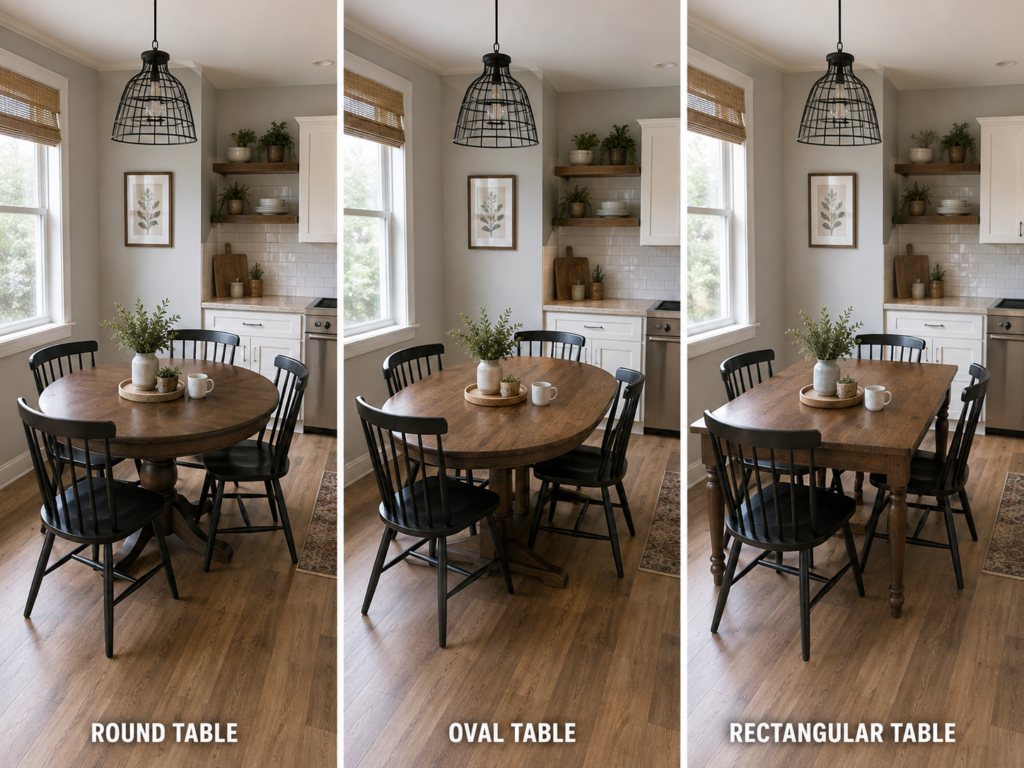
Round tables work well when the table is a gathering spot rather than a workspace. There are no corners to bump into, which matters if you have young kids, and everyone can see everyone else, which makes conversation easier. The trade-off: round tables are less efficient for seating a lot of people in a small footprint, since the shape doesn’t stretch the way a rectangle does.
Rectangular tables are the most flexible for families that use the table for homework, meal prep overflow, and eating all in the same day. They also fit more naturally against a wall or in a narrow kitchen, since one side can be pushed flush.
Oval tables split the difference — they give you the seating capacity of a rectangle with the softer, safer edges of a round table. They work particularly well in kitchens where the walking path curves around the table rather than going straight past it.
Square tables are useful in nearly square breakfast nooks, but they get cramped past four people unless you go quite large.
Things to consider: A rectangular table in a small square room will almost always look and feel more crowded than a round table of similar seating capacity — the unused floor space in the corners becomes dead space instead of clearance.
4. Match the Table to Your Kitchen’s Traffic Flow
Think about how people actually move through the kitchen during a normal weeknight — from the fridge to the stove, from the sink to the table, in and out of the back door if that’s a path in your home.
A table dropped into the middle of that path, even a nicely sized one, creates friction every single day. The fix isn’t always a smaller table — sometimes it’s rotating the table 90 degrees, or pushing one long side against a wall so the walkway shifts around the open end instead of through the middle.
If your kitchen has a natural “work triangle” between the stove, sink, and fridge, keep the table outside that triangle when possible. It keeps the cooking zone clear and stops the table from becoming a landing spot for grocery bags and mail mid-cook.
Common mistake: placing the table so a chair backs directly into a walkway used to reach the stove or fridge. It seems fine when the kitchen is empty, but it becomes a daily bottleneck once someone’s cooking and someone else is trying to get past. Fix it by shifting the table toward a wall or corner, even if it means losing a seat on one side.
5. Choose a Material Based on How Hard It Gets Used
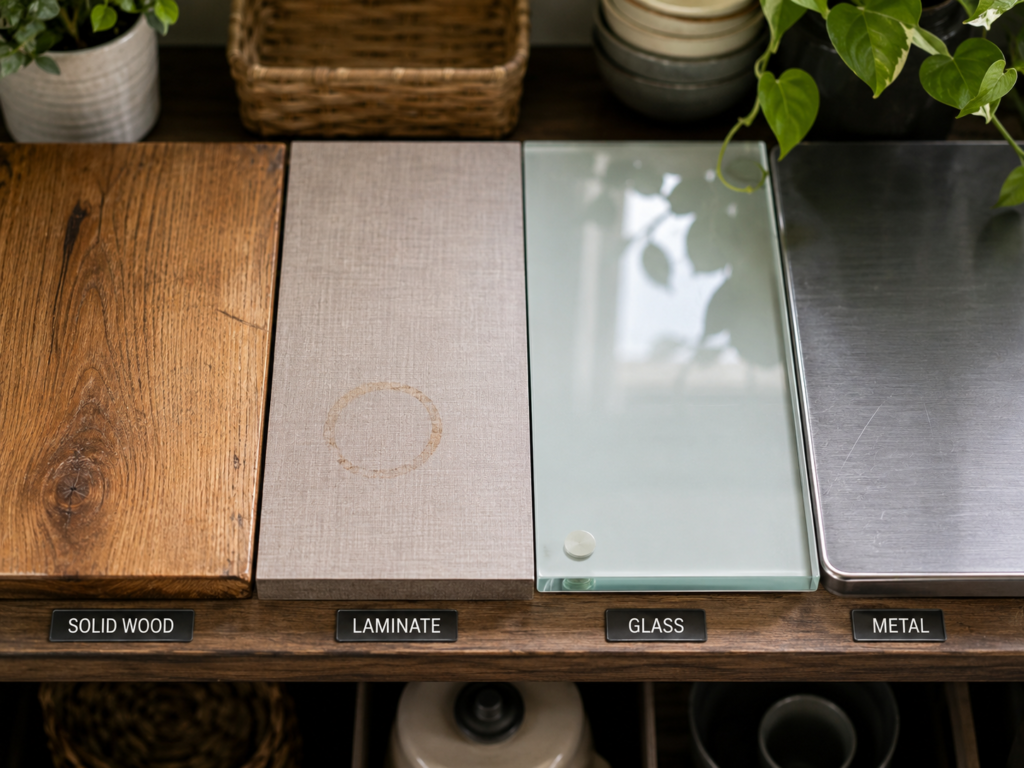
Kitchen tables take more daily abuse than almost any other piece of furniture in the house — spills, homework pencils, hot dishes, kids climbing on chairs. Material matters more here than in most rooms.
- Solid wood (oak, acacia, walnut) holds up well long-term and can be refinished when it gets scratched, but it needs occasional care — coasters, trivets, and periodic oiling or resealing depending on the finish.
- Engineered wood / veneer costs less and looks similar to solid wood at first, but it doesn’t refinish well and can peel or chip at the edges over years of use. It’s a reasonable choice for a starter table or a rental.
- Laminate is the most kid-and-spill resistant option and wipes clean easily, making it a practical pick for families with young children, though it doesn’t have the warmth or repairability of real wood.
- Glass looks clean and can make a small kitchen feel more open since it doesn’t visually block the room, but it shows fingerprints and water spots constantly and isn’t ideal with toddlers around sharp edges.
- Metal (often paired with a wood or laminate top) tends to be very durable and easy to clean, and works well in more industrial or modern kitchen styles.
Best for families with young kids: laminate or a wood table with a durable sealed finish. Best for long-term investment: solid wood — it’s more expensive upfront but survives refinishing rather than replacement. Best for renters or first apartments: engineered wood or a simple metal-and-laminate combo, since the lower cost matters more than long-term durability.
6. Get the Height and Proportions Right
Standard kitchen tables sit around 28–30 inches high, which pairs with standard dining chairs around 18 inches seat height. If you’re mixing in a bench, counter stools, or a kitchen island as informal seating, double-check the heights work together — a 36-inch counter-height table needs counter-height stools, not standard chairs, or the proportions will look and feel off.
Proportion matters with the room, too. A table that’s the right size on paper can still look wrong if it’s too low-profile for a room with tall ceilings, or too bulky for a cozy breakfast nook with a low window. As a general guide, leave roughly 6 inches of clearance between the table height and the underside of any pendant light hanging above it, and center the fixture over the table rather than the room.
7. Think About Storage — Especially in Small Kitchens
If your kitchen doesn’t have a separate dining room, the table often ends up doing double duty as extra storage and workspace. A few options that solve this without adding clutter, including ideas from our dining room storage cabinet ideas:
- Tables with a built-in shelf underneath — useful for stacking cookbooks, a fruit bowl, or linens, keeping the counters clearer.
- Bench seating on one side with a lift-top or storage drawer underneath, which works well for stashing kids’ art supplies or table linens out of sight.
- Drop-leaf or gateleg tables that fold down against a wall when not in full use, freeing floor space for a small kitchen that needs to flex between “dining” and “walkway” throughout the day.
Best for storage-strapped kitchens: a table with a lower shelf or a storage bench on one side. Best for tiny apartments: a drop-leaf table that can shrink down to a narrow console when it’s not mealtime.
8. Match the Style to the Rest of the Kitchen — Without Overthinking It
The table doesn’t need to match your cabinets exactly, but it should feel like it belongs in the same room. A warm, distressed wood table tends to soften a kitchen with a lot of cool metal and stainless steel. A simple black or white table with clean lines fits naturally into a more modern kitchen with flat-panel cabinetry.
If you’re unsure, a natural wood tone in a mid-brown shade is the safest long-term choice — it works with warm and cool kitchen palettes alike and doesn’t lock you into one specific design trend the way a very light “whitewashed” or very dark espresso finish might.
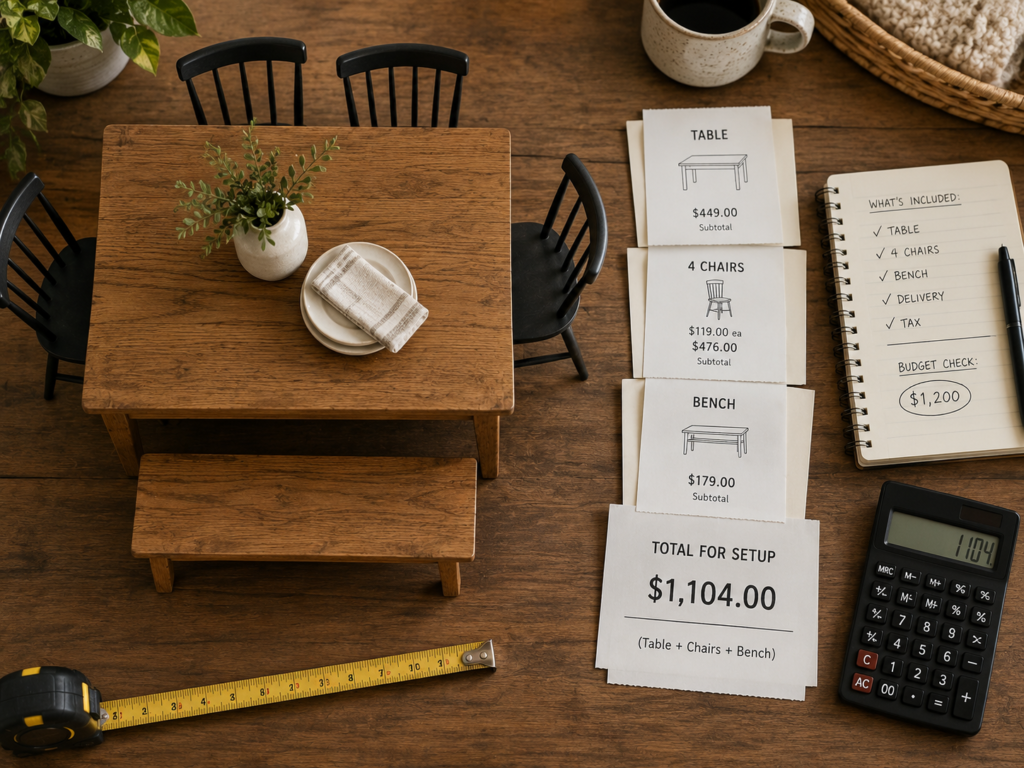
9. Set a Budget That Accounts for the Whole Setup, Not Just the Table
The table price tag is rarely the full cost. Chairs, in particular, often add up to more than the table itself, especially if you’re buying six of them. Before you fall in love with a specific table, price out the chairs or bench you’ll pair with it.
A few ways to manage the total cost without compromising too much:
- Buy the table first, then mix in more affordable chairs — matching wood tones instead of matching exact chair styles.
- Look for tables with removable leaves rather than paying for a permanently large table you only need seasonally.
- Consider a bench for one side instead of two chairs — it’s usually cheaper per seat and more forgiving with kids climbing in and out.
Best budget-conscious approach: a solid but simple wood or laminate table, paired with mismatched or budget chairs rather than a matched dining set.
How to Choose the Right Option for Your Family
If you’re still deciding between a few options, here’s how the main choices stack up against each other:
| Priority | Best Choice |
|---|---|
| Small kitchen, tight walkway | Round or oval, 36–42 inches |
| Growing family, occasional guests | Extendable rectangular or oval |
| Toddlers or young kids | Laminate or sealed wood, round shape |
| Renting or first apartment | Engineered wood, drop-leaf if space is tight |
| Frequent hosting | Rectangular with a leaf, 72+ inches extended |
| Long-term investment | Solid wood, standard rectangular or oval |
| Storage-limited kitchen | Table with a shelf or storage bench |
Common Mistakes to Avoid
Buying a table that’s the right size for the room but the wrong size for the family. A table can fit the floor space perfectly and still be too small once you’re seating six people for a holiday dinner. Solve this upfront with an extendable table rather than trying to squeeze extra chairs around a fixed size later.
Ignoring chair clearance. People measure the table but forget that chairs need to slide out and that someone needs to walk behind a seated person. This is the single most common reason a table feels “too big” in a room where the table itself would technically fit.
Choosing a material that doesn’t match daily life. A pale, unsealed wood table in a house with young kids and daily spaghetti dinners is going to show stains fast. Match the material to how the table actually gets used, not just how it looks in photos.
Centering the table on the room instead of the walkway. A table centered on the room’s dimensions can still block the most-used path through the kitchen. Center it on how people move, not on the square footage.
Overlooking lighting. A table that sits in a dim corner gets used less for homework or meals and more as a catch-all surface for mail and bags. If there’s no natural light above it, a pendant fixture makes a bigger functional difference than people expect.
Tips for Small-Space Families
If you’re working with a compact kitchen or an open-plan apartment where the dining area shares space with the living room:
- A round table pushed against a wall on one side can free up a walking path without losing much seating.
- Stools that slide fully under the table when not in use save more floor space than standard chairs.
- A drop-leaf table against a wall can function as a console day-to-day and expand only when needed for meals.
- Light-colored table legs (versus a solid, heavy base) make the table visually lighter in a small room, even at the same physical footprint.
Frequently Asked Questions
What size kitchen table do I need for a family of four? A 48-inch round table or a 60-inch rectangular table comfortably seats four with some room to spare, and either can typically flex to seat six in a pinch if needed.
Is a round or rectangular table better for a small kitchen? Round tables generally work better in small or oddly shaped kitchens because they don’t have corners that eat into walkway space, and they make the room feel more open.
How much space should be between the table and the wall? Aim for at least 36 inches of clearance between the table’s edge and the nearest wall or counter, so chairs can be pulled out and someone can walk past a seated person.
What’s the most durable material for a kitchen table with kids? Laminate is the easiest to clean and most spill-resistant, while a solid wood table with a well-sealed finish offers durability with more character and the option to refinish later.
Should I buy an extendable table even if I don’t need the extra seats now? If your family is likely to grow or you host a few times a year, yes — an extendable table costs more upfront but avoids replacing the whole set later.
Conclusion
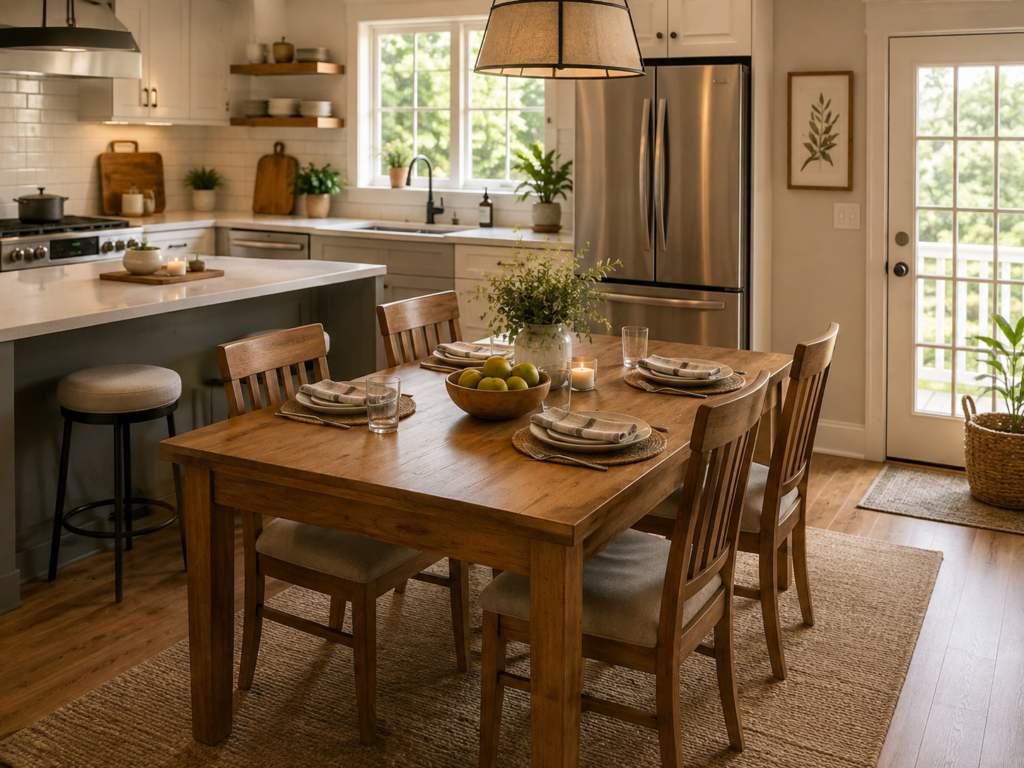
The right kitchen table isn’t the one that looks best in a catalog — it’s the one that fits your room’s actual clearance, seats your family without crowding, and holds up to how you really use it day to day. Start with measurements and seating needs, let shape and material follow from there, and the style decisions become a lot easier once the function is settled.