
The fastest way to avoid buying the wrong small kitchen fridge is to measure the entire installation path—not just the empty space where the refrigerator will sit.
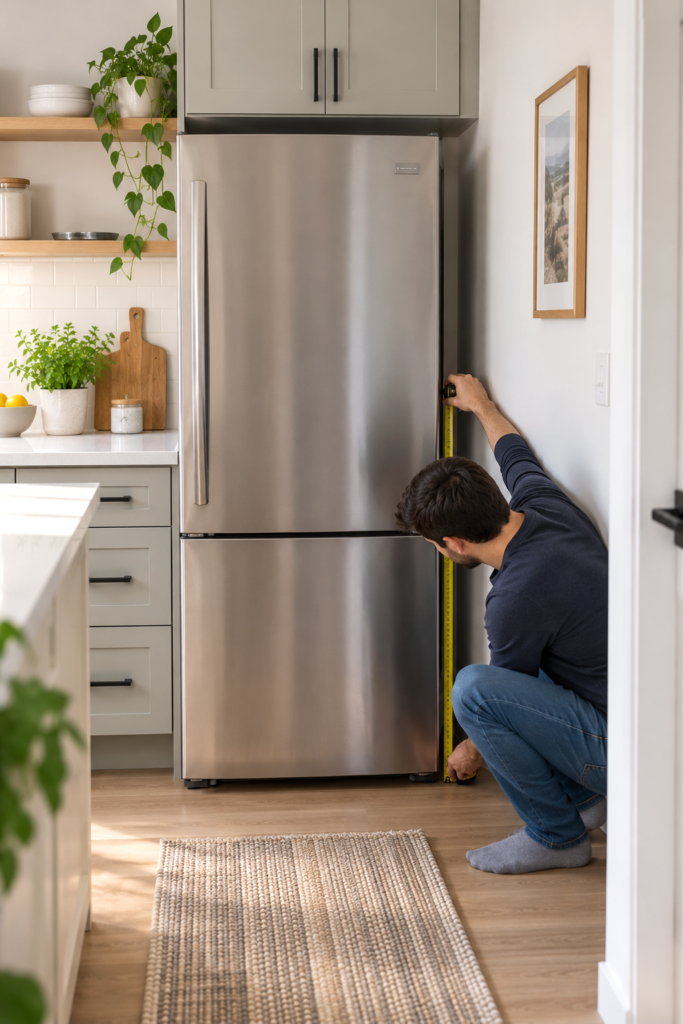
A refrigerator that is 28 inches wide on paper can still be a terrible fit once you account for the door swing, wall clearance, countertop overhang, and the route through your home. Before you fall for a stylish model, grab a tape measure and check these seven measurements.
1. Measure the Full Width of the Refrigerator Opening
Start with the obvious measurement: the width of the space where the refrigerator will live.
Measure from cabinet edge to cabinet edge at the top, middle, and bottom. Older kitchens are not always perfectly square, and a few millimeters of difference matters when you’re trying to squeeze in a full-size appliance.
Don’t measure only the refrigerator body. Check the manufacturer’s listed width and leave the required installation clearance shown in the manual.
For example, a GE 17.5 cu. ft. top-freezer refrigerator is around 28 inches wide, making it considerably easier to place in a tight kitchen than many wider French-door models.
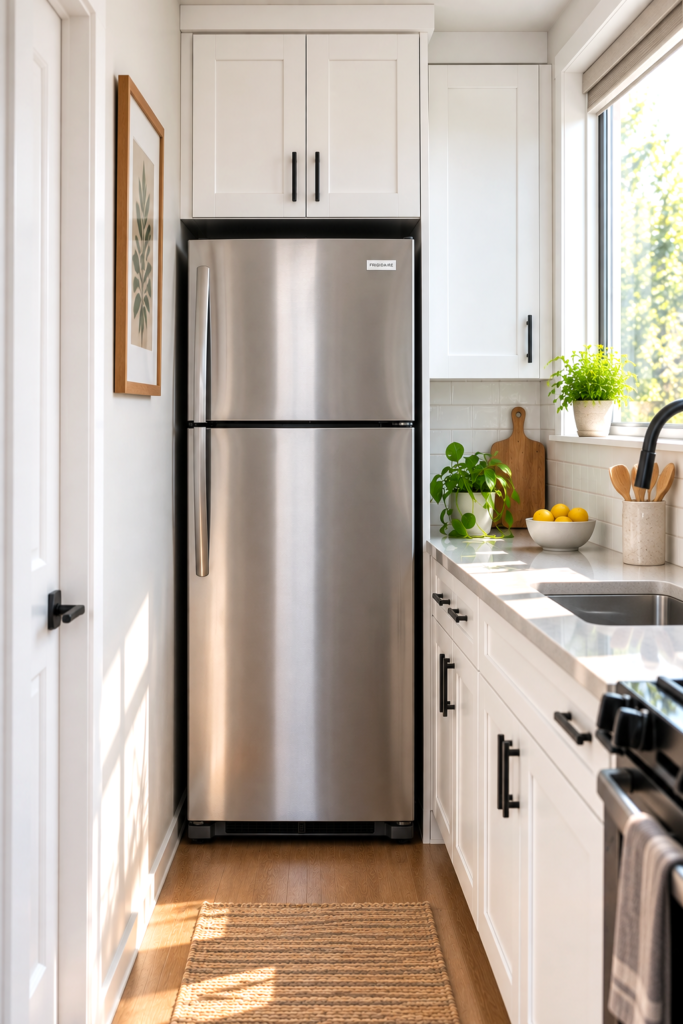
2. Check Refrigerator Depth — Not Just Width
Depth is where many small-kitchen refrigerator purchases go wrong.
A refrigerator might fit the opening perfectly from side to side but stick several inches farther into the kitchen than expected. In a narrow galley kitchen, that extra depth can turn an already-tight walkway into an obstacle.
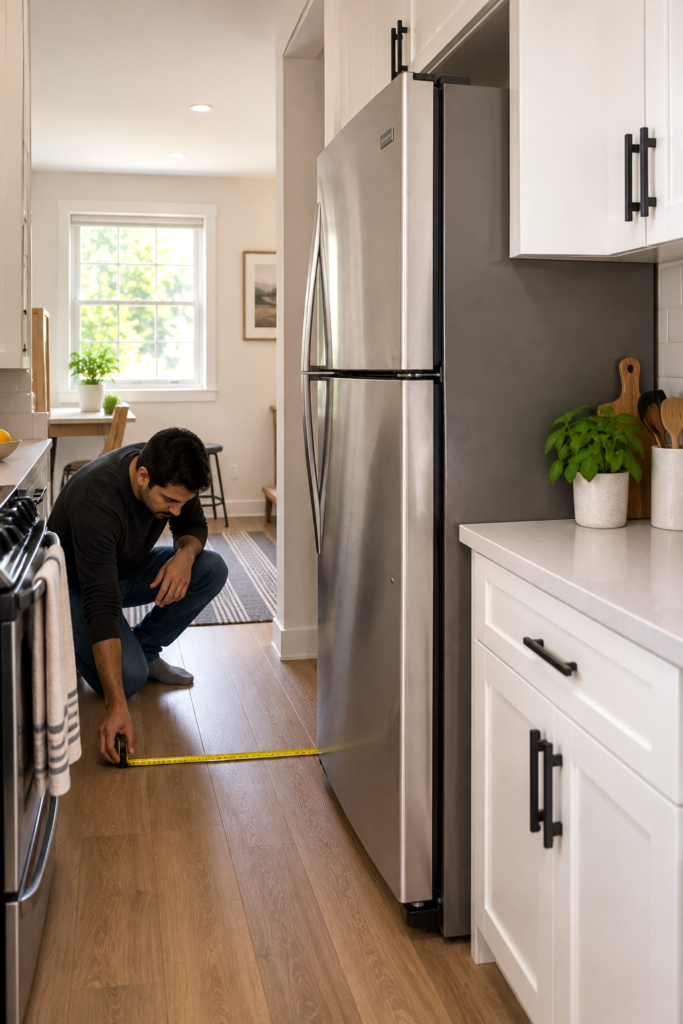
Measure from the back wall to the front edge of the surrounding countertop, then compare that number with the refrigerator’s cabinet depth.
I’d skip an unnecessarily deep refrigerator in a genuinely cramped kitchen. A slightly smaller refrigerator that keeps the walkway comfortable is more useful than a huge appliance that makes the room awkward to move through.
Also check whether the manufacturer’s depth measurement includes the handles and doors. Those dimensions are not always presented the same way between brands.
3. Measure the Height to the Cabinet Above
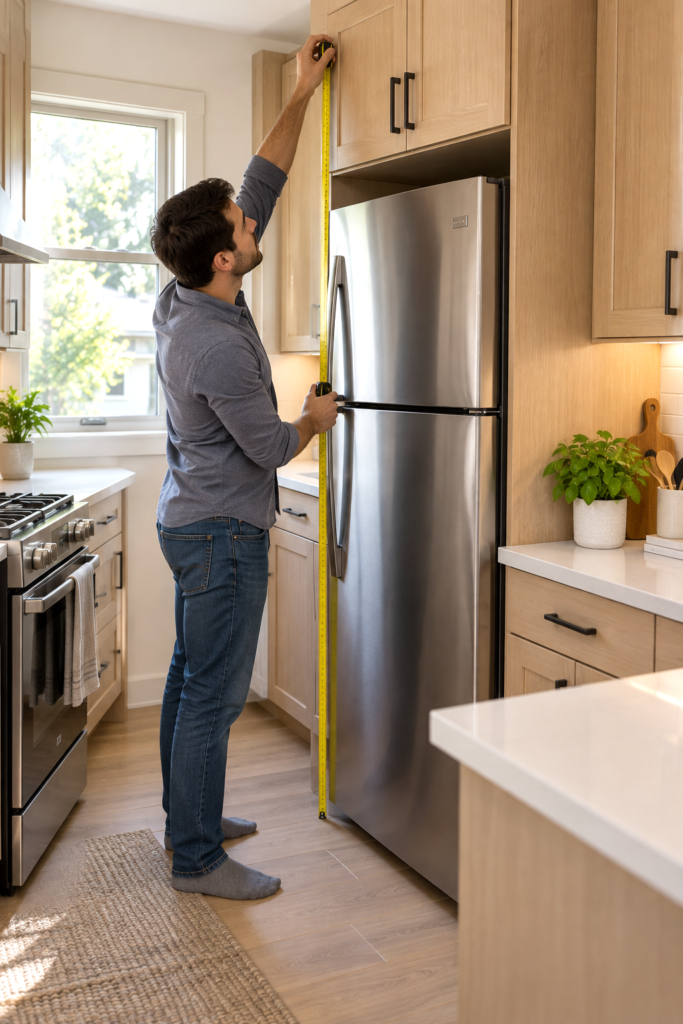
The height of the refrigerator opening matters just as much as its width.
Measure from the floor to the lowest point of the cabinet, shelf, or trim above the refrigerator. Then compare it with the refrigerator’s total height.
Don’t assume a refrigerator listed as 67 inches tall will fit a space that looks like it has 67 inches available. You need room to actually maneuver the appliance into position, and some models have adjustable feet or ventilation requirements.
A useful example: a kitchen with a 70-inch opening might technically accommodate a refrigerator around 68–69 inches tall, but the exact installation clearance depends on the model.
Check the manufacturer’s installation diagram before ordering.
4. Measure Door-Swing Clearance
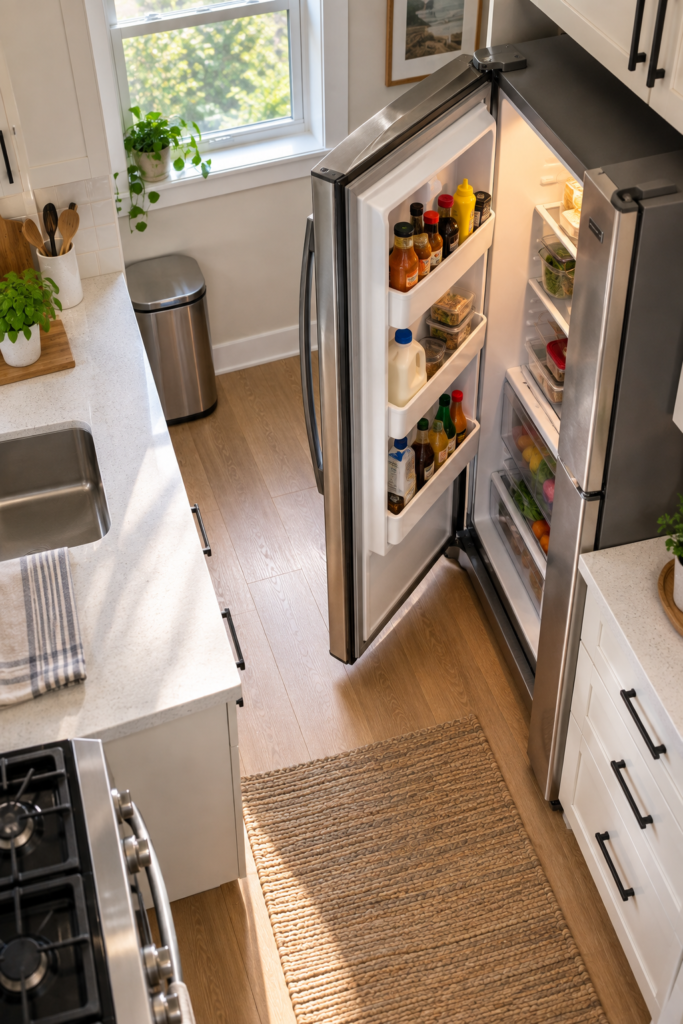
This measurement is easy to forget and one of the most frustrating mistakes to discover after delivery.
Open the refrigerator door on your existing appliance and observe what it hits. Then measure the space available on both sides of the planned refrigerator.
Pay attention to:
- Nearby walls
- Kitchen islands
- Cabinet doors
- Drawers
- Oven handles
- The opposite side of a narrow walkway
A refrigerator that physically fits into the opening might still be unusable because the door cannot open far enough to pull out a crisper drawer.
For a small kitchen, I’d favor a refrigerator with a door configuration that works with the room’s traffic pattern, rather than choosing a model purely because it offers more storage.
5. Measure the Delivery Path Before You Buy
This is the measurement people skip until the delivery crew arrives.
Measure every tight point between the front door and the refrigerator location:
- Front doorway
- Hallway
- Interior doors
- Stairway or elevator
- Kitchen entrance
- Final refrigerator opening
A refrigerator might fit perfectly inside the kitchen but fail to pass through a 30-inch doorway once packaging is included.
Take measurements with doors open or temporarily removed only when the delivery instructions allow it. Also check whether the refrigerator doors can be removed for delivery.
Real-world example: imagine a 10×10-foot kitchen in an older apartment. You find a refrigerator that fits the 29-inch-wide kitchen opening, but the hallway leading to the kitchen is only 28 inches wide. That refrigerator is not your solution—the delivery route is the problem.
6. Check the Counter and Wall Clearance
Small kitchens need breathing room around the refrigerator.
Measure the distance between the refrigerator and nearby walls, countertops, or cabinets. Then check the manufacturer’s required clearance for ventilation.
This matters particularly with refrigerators placed directly against a side wall. The door might need to open wider than the body of the refrigerator suggests.
Look at the hinge side, not only the front width.
For example, a 28-inch refrigerator placed against a wall could require considerably more usable space beside it for the door to swing open properly.
7. Measure the Space You Actually Need Inside
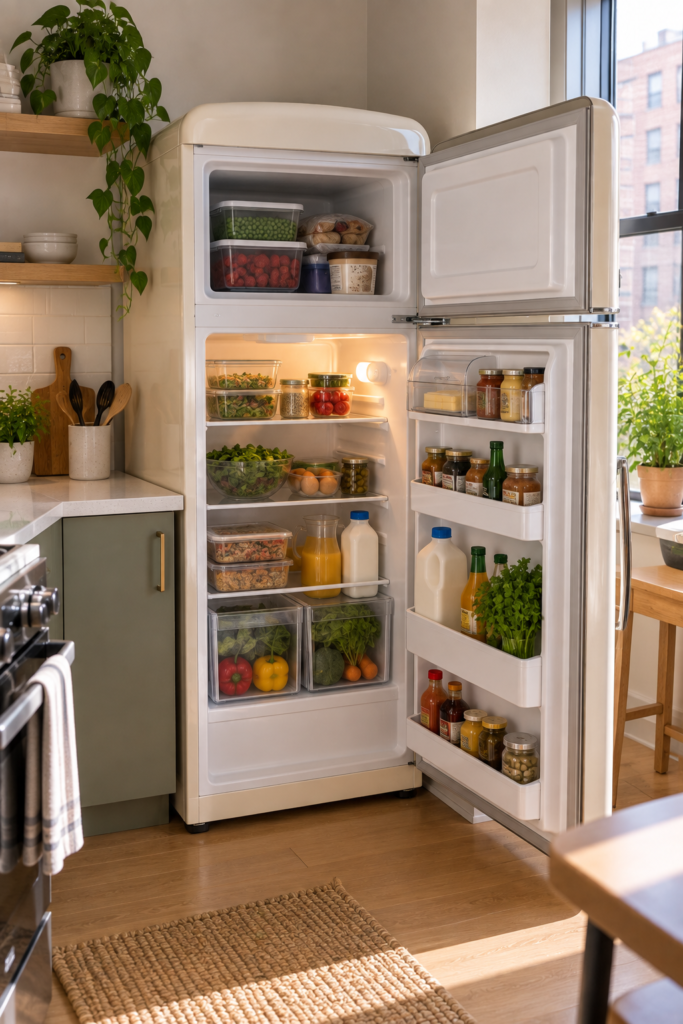
A small kitchen refrigerator should be compact outside without becoming frustrating inside.
Think about what you actually store. A couple living in a small apartment might need more refrigerator shelf space than freezer space, while someone who batch-cooks every weekend might need a larger freezer.
Don’t judge capacity only by cubic feet.
Look at the interior layout:
- Can a large food container fit upright?
- Are the shelves adjustable?
- How wide are the door bins?
- Does the freezer have usable vertical space?
- Can you remove or reposition shelves?
- Is there enough room for your largest everyday items?
A Galanz 10 cu. ft. retro top-freezer refrigerator, for example, takes a different approach from a larger full-size refrigerator: it prioritizes a smaller overall footprint while still providing a separate freezer compartment.
A Simple Small-Kitchen Fridge Measurement Checklist
Before placing an order, write these numbers down:
| Measurement | What to check |
|---|---|
| Opening width | Cabinet-to-cabinet space |
| Opening height | Floor to lowest cabinet or trim |
| Available depth | Wall to countertop/front obstruction |
| Door clearance | Space required for full door opening |
| Delivery width | Narrowest doorway or hallway |
| Side clearance | Wall and cabinet space beside hinges |
| Interior capacity | Storage needed for your household |
Keep this list on your phone while comparing refrigerators. It takes five minutes and could prevent an expensive return.
What I Would Prioritize in a Small Kitchen
For a genuinely tight kitchen, I would prioritize width, door clearance, and depth before fancy features.
An external water dispenser, oversized freezer, or complicated smart-home system won’t solve a refrigerator that blocks your kitchen drawer.
Look for the dimensions first. Then consider storage layout, energy efficiency, finish, and features.
A simple top-freezer refrigerator also deserves more attention than it gets. Models from brands such as GE and Galanz offer compact configurations without forcing you into an enormous French-door design.
The goal isn’t to buy the smallest refrigerator possible. It’s to buy the largest refrigerator that fits comfortably and remains easy to use.
FAQ
How much space should I leave around a refrigerator?
The exact clearance depends on the refrigerator model and installation instructions. Check the manufacturer’s installation guide for the required top, rear, and side clearances rather than using a universal number.
Is a counter-depth refrigerator worth it for a small kitchen?
It can be, especially when refrigerator depth is the main problem. Counter-depth models reduce how far the appliance projects into the room, but they also give up some interior storage compared with deeper models. Compare usable capacity before paying extra for the counter-depth design.
Which refrigerator door style works best in a narrow kitchen?
A single-door or top-freezer configuration often works well in tight layouts because it avoids the wide door footprint of some French-door designs. Still, the hinge position and surrounding wall clearance matter more than the label on the door style.
How do I know whether a refrigerator will fit through my front door?
Measure the narrowest doorway along the complete delivery route, then check the refrigerator’s delivery dimensions and whether the manufacturer allows door removal. Don’t rely on the refrigerator’s normal operating dimensions alone.
The One Mistake to Avoid
The most common mistake is measuring only the refrigerator opening.
Before buying your small kitchen fridge, measure the opening, depth, door swing, surrounding clearance, and entire delivery route. A refrigerator that fits on paper but cannot open properly—or cannot reach the kitchen—is still the wrong refrigerator.